
+91 7304796979info@frameboxx.in
Enquire NowFind us
Frameboxx — Institute of Emerging Media
Courses
Admission
Placements
Workshops & Events
About Us
Contact
Enquire Now

3D Animation & VFX Courses

  • B.Sc. in 3D Animation & Visual Effects (Medhavi)
  • B.Sc Animation and VFX (TMV)
  • B.Sc. in 3D Animation & Visual Effects in collaboration with Green Gold Animation Studio
  • Diploma in Animation
  • M.Sc in Media Graphics in Animation & VFX
  • Specialization Program in 3D / VFX
  • MPAV: 3D Asset Creation
  • MPAV: FX & Dynamics
  • MPAV: Rigging & Animation
  • MPAV: Roto, Paint, Matchmove & Compositing

Game Design & Development Courses

  • B.Sc in Game Art
  • B.Sc. in Game Art in collaboration with GodSpeed Games
  • MPGA: Game Art
  • Advanced Program in Game Development
  • Expert Program in Game Development with Unity
  • Expert Program in Game Development with Unreal
  • Expert Program in Game Design & Production

Web Design & Development Courses

  • Expert Program : Web Development
  • Expert Program : Web & UI / UX Design

Graphic Design & Motion Graphics Courses

  • Expert Program: Graphic, Broadcast and Social Media Design
  • Expert Program: Graphic Designing & Video Editing
  • Expert Program: Graphic Designing
  • MPMG: Motion Graphics

Fashion Design Courses

  • Master Program In Fashion Design (MPFD)
  • Specialization Program in Fashion Design: Men's/Women's Wear (SPFD-M/W)
  • Expert Program in Fashion Communication (EPFC)
  • Expert Program in Fashion Styling, Image & Photography (EPFSIP)
  • Expert Program in Apparel Production Planning & Control (EPAPPC)
  • Expert Program in Marketing & Merchandising (EPMM)
  • Expert Program in Visual Communication (EPVC)
  • Expert Program in Textile Design (EPTD)
  • Specialization Program in Fashion Design Development using Digital Technology (SPDT)

Interior Design Courses

  • Master Program In Interior Design (MPID)
  • Specialisation Program in Interior Design: Residential/Commercial (SPID-R/C)
  • Specialization Program in Vastu Shastra (SPVS)
  • Expert Program in Kitchen Design (EPKD)
  • Expert Program in Landscape Design (EPLD)

VR, Metaverse & Emerging Tech Courses

  • Future Technologies: Virtual Reality
  • Future Technologies: Metaverse
  • Future Technologies: Generative AI
  • Expert Program in VR Application Development

Photography Courses

  • Expert Program in Fashion Styling, Image & Photography (EPFSIP)

3D Animation & VFX Courses

  • B.Sc. in 3D Animation & Visual Effects (Medhavi)
  • B.Sc Animation and VFX (TMV)
  • B.Sc. in 3D Animation & Visual Effects in collaboration with Green Gold Animation Studio
  • Diploma in Animation
  • M.Sc in Media Graphics in Animation & VFX
  • Specialization Program in 3D / VFX
  • MPAV: 3D Asset Creation
  • MPAV: FX & Dynamics
  • MPAV: Rigging & Animation
  • MPAV: Roto, Paint, Matchmove & Compositing

Fashion Design Courses

  • Master Program In Fashion Design (MPFD)
  • Specialization Program in Fashion Design: Men's/Women's Wear (SPFD-M/W)
  • Expert Program in Fashion Communication (EPFC)
  • Expert Program in Fashion Styling, Image & Photography (EPFSIP)
  • Expert Program in Apparel Production Planning & Control (EPAPPC)
  • Expert Program in Marketing & Merchandising (EPMM)
  • Expert Program in Visual Communication (EPVC)
  • Expert Program in Textile Design (EPTD)
  • Specialization Program in Fashion Design Development using Digital Technology (SPDT)

Game Design & Development Courses

  • B.Sc in Game Art
  • B.Sc. in Game Art in collaboration with GodSpeed Games
  • MPGA: Game Art
  • Advanced Program in Game Development
  • Expert Program in Game Development with Unity
  • Expert Program in Game Development with Unreal
  • Expert Program in Game Design & Production

Interior Design Courses

  • Master Program In Interior Design (MPID)
  • Specialisation Program in Interior Design: Residential/Commercial (SPID-R/C)
  • Specialization Program in Vastu Shastra (SPVS)
  • Expert Program in Kitchen Design (EPKD)
  • Expert Program in Landscape Design (EPLD)

Web Design & Development Courses

  • Expert Program : Web Development
  • Expert Program : Web & UI / UX Design

VR, Metaverse & Emerging Tech Courses

  • Future Technologies: Virtual Reality
  • Future Technologies: Metaverse
  • Future Technologies: Generative AI
  • Expert Program in VR Application Development

Graphic Design & Motion Graphics Courses

  • Expert Program: Graphic, Broadcast and Social Media Design
  • Expert Program: Graphic Designing & Video Editing
  • Expert Program: Graphic Designing
  • MPMG: Motion Graphics

Photography Courses

  • Expert Program in Fashion Styling, Image & Photography (EPFSIP)
Frameboxx

Call us:

+91 7304796979

info@frameboxx.in

Follow Us

About Us

  • Who We Are
  • Vision & Values
  • Leadership & Mentors
  • Industry Partners
  • Accreditations & Awards
  • Our Infrastructure
  • Careers at Frameboxx

Links

  • Webinars
  • Blog
  • Download App
  • Downloads & Brochures
  • Hall of Fame
  • Privacy Policy
  • Terms and Conditions

Courses

  • Degree Programs
  • Specialization Program
  • Master Programs
  • Expert Programs
  • Interior Design Courses
  • Fashion Design Courses

Subscribe to
Our Newsletter

© 2026 Frameboxx Animation And Visual Effects Private Limited. All rights reserved.

+91 7304796979info@frameboxx.in
Enquire NowFind us
Frameboxx — Institute of Emerging Media
Courses
Admission
Placements
Workshops & Events
About Us
Contact
Enquire Now

3D Animation & VFX Courses

  • B.Sc. in 3D Animation & Visual Effects (Medhavi)
  • B.Sc Animation and VFX (TMV)
  • B.Sc. in 3D Animation & Visual Effects in collaboration with Green Gold Animation Studio
  • Diploma in Animation
  • M.Sc in Media Graphics in Animation & VFX
  • Specialization Program in 3D / VFX
  • MPAV: 3D Asset Creation
  • MPAV: FX & Dynamics
  • MPAV: Rigging & Animation
  • MPAV: Roto, Paint, Matchmove & Compositing

Game Design & Development Courses

  • B.Sc in Game Art
  • B.Sc. in Game Art in collaboration with GodSpeed Games
  • MPGA: Game Art
  • Advanced Program in Game Development
  • Expert Program in Game Development with Unity
  • Expert Program in Game Development with Unreal
  • Expert Program in Game Design & Production

Web Design & Development Courses

  • Expert Program : Web Development
  • Expert Program : Web & UI / UX Design

Graphic Design & Motion Graphics Courses

  • Expert Program: Graphic, Broadcast and Social Media Design
  • Expert Program: Graphic Designing & Video Editing
  • Expert Program: Graphic Designing
  • MPMG: Motion Graphics

Fashion Design Courses

  • Master Program In Fashion Design (MPFD)
  • Specialization Program in Fashion Design: Men's/Women's Wear (SPFD-M/W)
  • Expert Program in Fashion Communication (EPFC)
  • Expert Program in Fashion Styling, Image & Photography (EPFSIP)
  • Expert Program in Apparel Production Planning & Control (EPAPPC)
  • Expert Program in Marketing & Merchandising (EPMM)
  • Expert Program in Visual Communication (EPVC)
  • Expert Program in Textile Design (EPTD)
  • Specialization Program in Fashion Design Development using Digital Technology (SPDT)

Interior Design Courses

  • Master Program In Interior Design (MPID)
  • Specialisation Program in Interior Design: Residential/Commercial (SPID-R/C)
  • Specialization Program in Vastu Shastra (SPVS)
  • Expert Program in Kitchen Design (EPKD)
  • Expert Program in Landscape Design (EPLD)

VR, Metaverse & Emerging Tech Courses

  • Future Technologies: Virtual Reality
  • Future Technologies: Metaverse
  • Future Technologies: Generative AI
  • Expert Program in VR Application Development

Photography Courses

  • Expert Program in Fashion Styling, Image & Photography (EPFSIP)

3D Animation & VFX Courses

  • B.Sc. in 3D Animation & Visual Effects (Medhavi)
  • B.Sc Animation and VFX (TMV)
  • B.Sc. in 3D Animation & Visual Effects in collaboration with Green Gold Animation Studio
  • Diploma in Animation
  • M.Sc in Media Graphics in Animation & VFX
  • Specialization Program in 3D / VFX
  • MPAV: 3D Asset Creation
  • MPAV: FX & Dynamics
  • MPAV: Rigging & Animation
  • MPAV: Roto, Paint, Matchmove & Compositing

Fashion Design Courses

  • Master Program In Fashion Design (MPFD)
  • Specialization Program in Fashion Design: Men's/Women's Wear (SPFD-M/W)
  • Expert Program in Fashion Communication (EPFC)
  • Expert Program in Fashion Styling, Image & Photography (EPFSIP)
  • Expert Program in Apparel Production Planning & Control (EPAPPC)
  • Expert Program in Marketing & Merchandising (EPMM)
  • Expert Program in Visual Communication (EPVC)
  • Expert Program in Textile Design (EPTD)
  • Specialization Program in Fashion Design Development using Digital Technology (SPDT)

Game Design & Development Courses

  • B.Sc in Game Art
  • B.Sc. in Game Art in collaboration with GodSpeed Games
  • MPGA: Game Art
  • Advanced Program in Game Development
  • Expert Program in Game Development with Unity
  • Expert Program in Game Development with Unreal
  • Expert Program in Game Design & Production

Interior Design Courses

  • Master Program In Interior Design (MPID)
  • Specialisation Program in Interior Design: Residential/Commercial (SPID-R/C)
  • Specialization Program in Vastu Shastra (SPVS)
  • Expert Program in Kitchen Design (EPKD)
  • Expert Program in Landscape Design (EPLD)

Web Design & Development Courses

  • Expert Program : Web Development
  • Expert Program : Web & UI / UX Design

VR, Metaverse & Emerging Tech Courses

  • Future Technologies: Virtual Reality
  • Future Technologies: Metaverse
  • Future Technologies: Generative AI
  • Expert Program in VR Application Development

Graphic Design & Motion Graphics Courses

  • Expert Program: Graphic, Broadcast and Social Media Design
  • Expert Program: Graphic Designing & Video Editing
  • Expert Program: Graphic Designing
  • MPMG: Motion Graphics

Photography Courses

  • Expert Program in Fashion Styling, Image & Photography (EPFSIP)
Frameboxx

Call us:

+91 7304796979

info@frameboxx.in

Follow Us

About Us

  • Who We Are
  • Vision & Values
  • Leadership & Mentors
  • Industry Partners
  • Accreditations & Awards
  • Our Infrastructure
  • Careers at Frameboxx

Links

  • Webinars
  • Blog
  • Download App
  • Downloads & Brochures
  • Hall of Fame
  • Privacy Policy
  • Terms and Conditions

Courses

  • Degree Programs
  • Specialization Program
  • Master Programs
  • Expert Programs
  • Interior Design Courses
  • Fashion Design Courses

Subscribe to
Our Newsletter

© 2026 Frameboxx Animation And Visual Effects Private Limited. All rights reserved.

Creator typing on a laptop keyboard

Blog

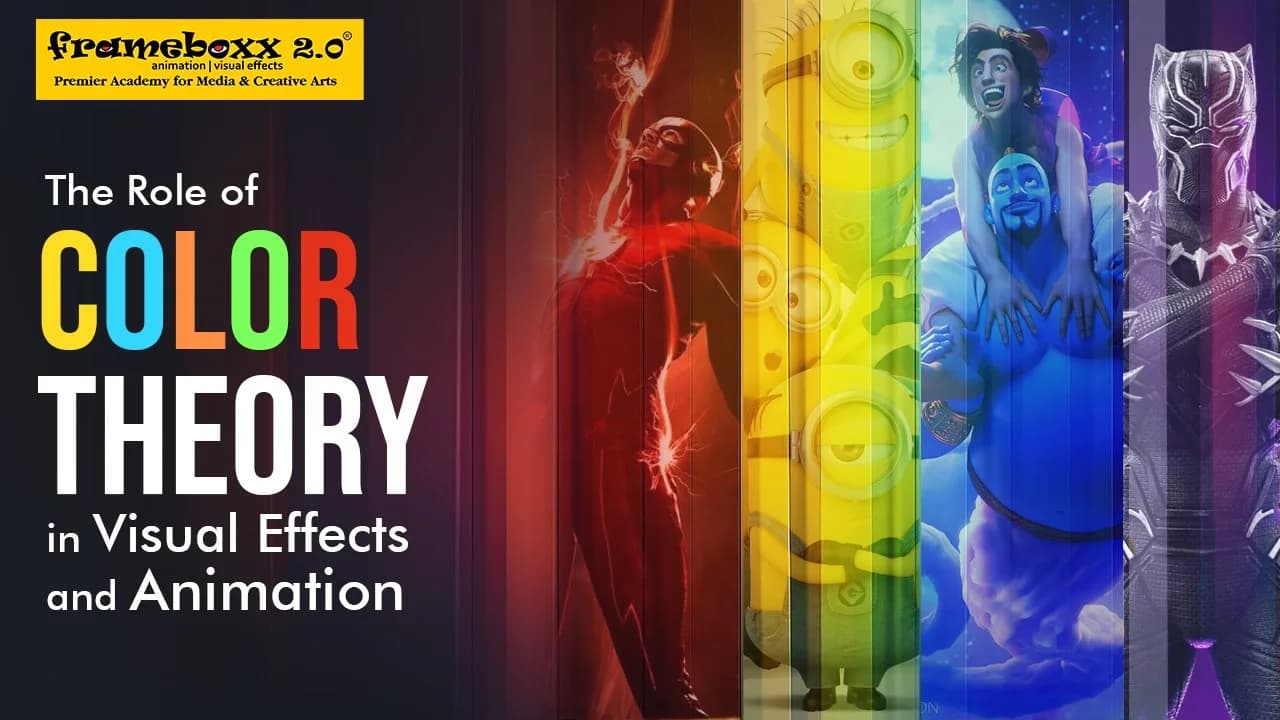
The Role of Color Theory in Visual Effects and Animation

  • 20 Jun 2024
  • 3,457 views
The Role of Color Theory in Visual Effects and Animation

Introduction

Eye-catching content makes viewers rewatch the content you produce and launch. This factor doubles down on the importance of color theory in visual effects. Not sure how? Well, imagine an advertisement in grayscale and another in vibrant colors.

Which will attract the buyer the most to purchase or watch a movie more often?

Of course, the answer is the one which is in colors.

Color theory has a massive impact on your visual effects as well. Add contrasting layers to make a scene or sequence more nuanced.

Have you seen Heeramandi by Sanjay Leela Bhansali recently? Or House of Dragons Season 2? You will see what we are referring to here if you love the art and the background in each show.

The magic is possible when you focus on color correcting and grading.

Learn more about it when you enroll in a comprehensive and full-fledged course from Frameboxx 2.0. Meanwhile, scroll the post below. We have a lot more insights to share for your knowledge and curiosity.

Color theory in animation

How do visual effect artists know how to pop out a scene and make it more memorable? Do they think it through or have a mathematical or scientific explanation?

Your answer lies in the color theory. The rules of its colors spark the beautiful amalgamation of art and science.

When you study color theory in visual effects or animation, you study topics like:

• Culture interference

• Color Psychology

• Color wheel

• Correlation between colors

These insights build the entire color theory. It develops with modern psychology, view preferences, and cultural intelligence.

After understanding the basics of color theory, you can create unique, eye-appealing visuals. You know what ticks the audience, and then rewatch or binge-watch the content.

Once you master the color theory, you can master your storytelling craft further.

What do we know of the color wheel in color theory?

A color wheel highlights the correlations and connections between colors. It has 12 parts or spectrums in the wheel. Know the major categories below for clarity.

Primary colors:

These are the foundational colors in the wheel, i.e., blue/yellow/green. You can't create them by adding two or more colors together. These are the standard ones. In fact, you make more colors by mixing them up in different proportions.

Secondary colors:

These are the ones you get after mixing primary ones for the first time. Example of such colors include green and purple.

Tertiary colors:

This is an exciting category you find and create by mixing primary and tertiary sets of colors. For example, mix yellow with green or purple.

Brief on color harmonies

Color harmonies are color groups that go well when blended or used together. These harmonies help to consider color pairings for visual effects and animated characters.

Some of the few harmonies are:

Analogous:

Such colors are close to one another if placed on the color wheel. However, one must necessarily be the primary among the three in the analogous pairing.

Complementary:

It is a pair of two colors that are opposite of each other when placed on the color wheel. These are best for choosing contrasts for your visual effects or setting up the background and foreground for the characters.

Monochromatic:

It is a single color but has multiple variations in its hue because of changing the saturation or color value. This pairing of color harmony is the simplest to choose among the three we mentioned in this section.

Role of color theory in visual effects

1. Making the color pop.

You can choose analogue and/or complementary colors from the color wheel in your visual effects. These pairings make the character and their surroundings pop for the long term.

You can make the surroundings greyscale or play with a single color and its variations. This is a prime example of how you choose a monochromatic pairing to make the color pop.

A color value shows which side of the color you want: light or dark. With darker colors, you can play with lighter shades in the foreground.

So, when you have color values defined, it's easier to pick and choose the hues, variations, or color harmonies.

In fact, with value contrast, you can appeal to a broader audience. It makes the color and palette more accessible on the screen, even for those with color blindness or visual impairment.

Example:

If you want a static art or game object to pop up, you will give those objects or elements lighter/brighter shades. The rest might fade slightly in the background or be covered in shadows.

Similarly, the objects with less energy and volume must be kept in dark hues, values, or contrast.

2. Decide major and minor color easily.

When you work in a grayscale background, it is easy to decide which color you want to be, main or minor.

The main colors, ideally, are the brightest ones with higher volume, value, and hues. They draw instant attention from the audience. Supporting or minor colors schemes are darker in shade, often translucent.

New VFX artists might feel the need to fill every new element or object on the screen with more hues and shades. That's the first mistake to commit. Understanding the minor and major colors helps to overcome this problem.

As a standard rule, you mustn't go crazy with saturation levels. Keep that minimum, at least for your minor color. That will help you separate the color pairing and contrast between different objects in your visual effect and animated projects.

In fact, removing two or more objects having the same color in the foreground helps to clear the confusion. You have clarity on which element, object, or character you want to highlight as the main part of the shot or scene. This will automatically cut out the noise or dissonance.

3. Make the scene eye-pleasing.

Do you need to soothe the audience's mood and create a distinct brand value through your campaigns? Visual effects and color theory come into play here. You can play with complimentary, monochromatic, and analogue pairing here.

Build more contrast in the scene with complimentary pairings and a little bit of distraction. Want your shot to be calm and pleasing at the same time? Go for an analogous color palette.

The Triadic palette helps you pick one major color, and the remaining two are the supporting ones. It will draw instant attention, while the lower saturation of the supporting colors promises to give a calming effect.

4. Welcoming a gradient effect in the entire set.

You can pick a monochromatic palette to add a gradient effect to your animated projects. Play around with one extreme to another regarding the hues, value, and saturation of a single color.

Tweak opacity if you want from one side to another. It will automatically bring more gradient effects to the entire set. You then don't need to manually make each frame or shot gradient with more effects or transitions.

Conclusion

From the copy above, we understood the grave importance of color theory in visual effects, art, or animated projects. The basic understanding came from color theory, color wheel, and color harmonies.

If you wish to explore fronts of visual effects and art, it's the best time to enroll in a course we offer at Frameboxx 2.0. Otherwise, feel free to explore related topics on the site.
Stories You May Like

How AI is Shaping the Future of UI/UX Design
Blog

How AI is Shaping the Future of UI/UX Design

21 Nov 2025

Read Article→
🎬 Top 10 Career Paths After Learning Animation & VFX
Blog

🎬 Top 10 Career Paths After Learning Animation & VFX

24 Oct 2025

Read Article→
Why Graphic Design is the Foundation of Every Creative Career
Blog

Why Graphic Design is the Foundation of Every Creative Career

11 Oct 2025

Read Article→
Top 5 Skills Every UI/UX Designer Needs in 2025
Blog

Top 5 Skills Every UI/UX Designer Needs in 2025

25 Sep 2025

Read Article→
Do You Need to Learn Every Software to Become a Successful Animator?
Blog

Do You Need to Learn Every Software to Become a Successful Animator?

08 Sep 2025

Read Article→
From Showreel to Studio: What Recruiters Look For in a VFX Demo Reel
Blog

From Showreel to Studio: What Recruiters Look For in a VFX Demo Reel

25 Aug 2025

Read Article→
How AI is Shaping the Future of UI/UX Design
Blog

How AI is Shaping the Future of UI/UX Design

21 Nov 2025

Read Article→
🎬 Top 10 Career Paths After Learning Animation & VFX
Blog

🎬 Top 10 Career Paths After Learning Animation & VFX

24 Oct 2025

Read Article→
Why Graphic Design is the Foundation of Every Creative Career
Blog

Why Graphic Design is the Foundation of Every Creative Career

11 Oct 2025

Read Article→
Top 5 Skills Every UI/UX Designer Needs in 2025
Blog

Top 5 Skills Every UI/UX Designer Needs in 2025

25 Sep 2025

Read Article→
Do You Need to Learn Every Software to Become a Successful Animator?
Blog

Do You Need to Learn Every Software to Become a Successful Animator?

08 Sep 2025

Read Article→
From Showreel to Studio: What Recruiters Look For in a VFX Demo Reel
Blog

From Showreel to Studio: What Recruiters Look For in a VFX Demo Reel

25 Aug 2025

Read Article→
Creator typing on a laptop keyboard

Blog

The Role of Color Theory in Visual Effects and Animation

  • 20 Jun 2024
  • 3,457 views
The Role of Color Theory in Visual Effects and Animation

Introduction

Eye-catching content makes viewers rewatch the content you produce and launch. This factor doubles down on the importance of color theory in visual effects. Not sure how? Well, imagine an advertisement in grayscale and another in vibrant colors.

Which will attract the buyer the most to purchase or watch a movie more often?

Of course, the answer is the one which is in colors.

Color theory has a massive impact on your visual effects as well. Add contrasting layers to make a scene or sequence more nuanced.

Have you seen Heeramandi by Sanjay Leela Bhansali recently? Or House of Dragons Season 2? You will see what we are referring to here if you love the art and the background in each show.

The magic is possible when you focus on color correcting and grading.

Learn more about it when you enroll in a comprehensive and full-fledged course from Frameboxx 2.0. Meanwhile, scroll the post below. We have a lot more insights to share for your knowledge and curiosity.

Color theory in animation

How do visual effect artists know how to pop out a scene and make it more memorable? Do they think it through or have a mathematical or scientific explanation?

Your answer lies in the color theory. The rules of its colors spark the beautiful amalgamation of art and science.

When you study color theory in visual effects or animation, you study topics like:

• Culture interference

• Color Psychology

• Color wheel

• Correlation between colors

These insights build the entire color theory. It develops with modern psychology, view preferences, and cultural intelligence.

After understanding the basics of color theory, you can create unique, eye-appealing visuals. You know what ticks the audience, and then rewatch or binge-watch the content.

Once you master the color theory, you can master your storytelling craft further.

What do we know of the color wheel in color theory?

A color wheel highlights the correlations and connections between colors. It has 12 parts or spectrums in the wheel. Know the major categories below for clarity.

Primary colors:

These are the foundational colors in the wheel, i.e., blue/yellow/green. You can't create them by adding two or more colors together. These are the standard ones. In fact, you make more colors by mixing them up in different proportions.

Secondary colors:

These are the ones you get after mixing primary ones for the first time. Example of such colors include green and purple.

Tertiary colors:

This is an exciting category you find and create by mixing primary and tertiary sets of colors. For example, mix yellow with green or purple.

Brief on color harmonies

Color harmonies are color groups that go well when blended or used together. These harmonies help to consider color pairings for visual effects and animated characters.

Some of the few harmonies are:

Analogous:

Such colors are close to one another if placed on the color wheel. However, one must necessarily be the primary among the three in the analogous pairing.

Complementary:

It is a pair of two colors that are opposite of each other when placed on the color wheel. These are best for choosing contrasts for your visual effects or setting up the background and foreground for the characters.

Monochromatic:

It is a single color but has multiple variations in its hue because of changing the saturation or color value. This pairing of color harmony is the simplest to choose among the three we mentioned in this section.

Role of color theory in visual effects

1. Making the color pop.

You can choose analogue and/or complementary colors from the color wheel in your visual effects. These pairings make the character and their surroundings pop for the long term.

You can make the surroundings greyscale or play with a single color and its variations. This is a prime example of how you choose a monochromatic pairing to make the color pop.

A color value shows which side of the color you want: light or dark. With darker colors, you can play with lighter shades in the foreground.

So, when you have color values defined, it's easier to pick and choose the hues, variations, or color harmonies.

In fact, with value contrast, you can appeal to a broader audience. It makes the color and palette more accessible on the screen, even for those with color blindness or visual impairment.

Example:

If you want a static art or game object to pop up, you will give those objects or elements lighter/brighter shades. The rest might fade slightly in the background or be covered in shadows.

Similarly, the objects with less energy and volume must be kept in dark hues, values, or contrast.

2. Decide major and minor color easily.

When you work in a grayscale background, it is easy to decide which color you want to be, main or minor.

The main colors, ideally, are the brightest ones with higher volume, value, and hues. They draw instant attention from the audience. Supporting or minor colors schemes are darker in shade, often translucent.

New VFX artists might feel the need to fill every new element or object on the screen with more hues and shades. That's the first mistake to commit. Understanding the minor and major colors helps to overcome this problem.

As a standard rule, you mustn't go crazy with saturation levels. Keep that minimum, at least for your minor color. That will help you separate the color pairing and contrast between different objects in your visual effect and animated projects.

In fact, removing two or more objects having the same color in the foreground helps to clear the confusion. You have clarity on which element, object, or character you want to highlight as the main part of the shot or scene. This will automatically cut out the noise or dissonance.

3. Make the scene eye-pleasing.

Do you need to soothe the audience's mood and create a distinct brand value through your campaigns? Visual effects and color theory come into play here. You can play with complimentary, monochromatic, and analogue pairing here.

Build more contrast in the scene with complimentary pairings and a little bit of distraction. Want your shot to be calm and pleasing at the same time? Go for an analogous color palette.

The Triadic palette helps you pick one major color, and the remaining two are the supporting ones. It will draw instant attention, while the lower saturation of the supporting colors promises to give a calming effect.

4. Welcoming a gradient effect in the entire set.

You can pick a monochromatic palette to add a gradient effect to your animated projects. Play around with one extreme to another regarding the hues, value, and saturation of a single color.

Tweak opacity if you want from one side to another. It will automatically bring more gradient effects to the entire set. You then don't need to manually make each frame or shot gradient with more effects or transitions.

Conclusion

From the copy above, we understood the grave importance of color theory in visual effects, art, or animated projects. The basic understanding came from color theory, color wheel, and color harmonies.

If you wish to explore fronts of visual effects and art, it's the best time to enroll in a course we offer at Frameboxx 2.0. Otherwise, feel free to explore related topics on the site.
Stories You May Like

How AI is Shaping the Future of UI/UX Design
Blog

How AI is Shaping the Future of UI/UX Design

21 Nov 2025

Read Article→
🎬 Top 10 Career Paths After Learning Animation & VFX
Blog

🎬 Top 10 Career Paths After Learning Animation & VFX

24 Oct 2025

Read Article→
Why Graphic Design is the Foundation of Every Creative Career
Blog

Why Graphic Design is the Foundation of Every Creative Career

11 Oct 2025

Read Article→
Top 5 Skills Every UI/UX Designer Needs in 2025
Blog

Top 5 Skills Every UI/UX Designer Needs in 2025

25 Sep 2025

Read Article→
Do You Need to Learn Every Software to Become a Successful Animator?
Blog

Do You Need to Learn Every Software to Become a Successful Animator?

08 Sep 2025

Read Article→
From Showreel to Studio: What Recruiters Look For in a VFX Demo Reel
Blog

From Showreel to Studio: What Recruiters Look For in a VFX Demo Reel

25 Aug 2025

Read Article→
How AI is Shaping the Future of UI/UX Design
Blog

How AI is Shaping the Future of UI/UX Design

21 Nov 2025

Read Article→
🎬 Top 10 Career Paths After Learning Animation & VFX
Blog

🎬 Top 10 Career Paths After Learning Animation & VFX

24 Oct 2025

Read Article→
Why Graphic Design is the Foundation of Every Creative Career
Blog

Why Graphic Design is the Foundation of Every Creative Career

11 Oct 2025

Read Article→
Top 5 Skills Every UI/UX Designer Needs in 2025
Blog

Top 5 Skills Every UI/UX Designer Needs in 2025

25 Sep 2025

Read Article→
Do You Need to Learn Every Software to Become a Successful Animator?
Blog

Do You Need to Learn Every Software to Become a Successful Animator?

08 Sep 2025

Read Article→
From Showreel to Studio: What Recruiters Look For in a VFX Demo Reel
Blog

From Showreel to Studio: What Recruiters Look For in a VFX Demo Reel

25 Aug 2025

Read Article→