


Blog
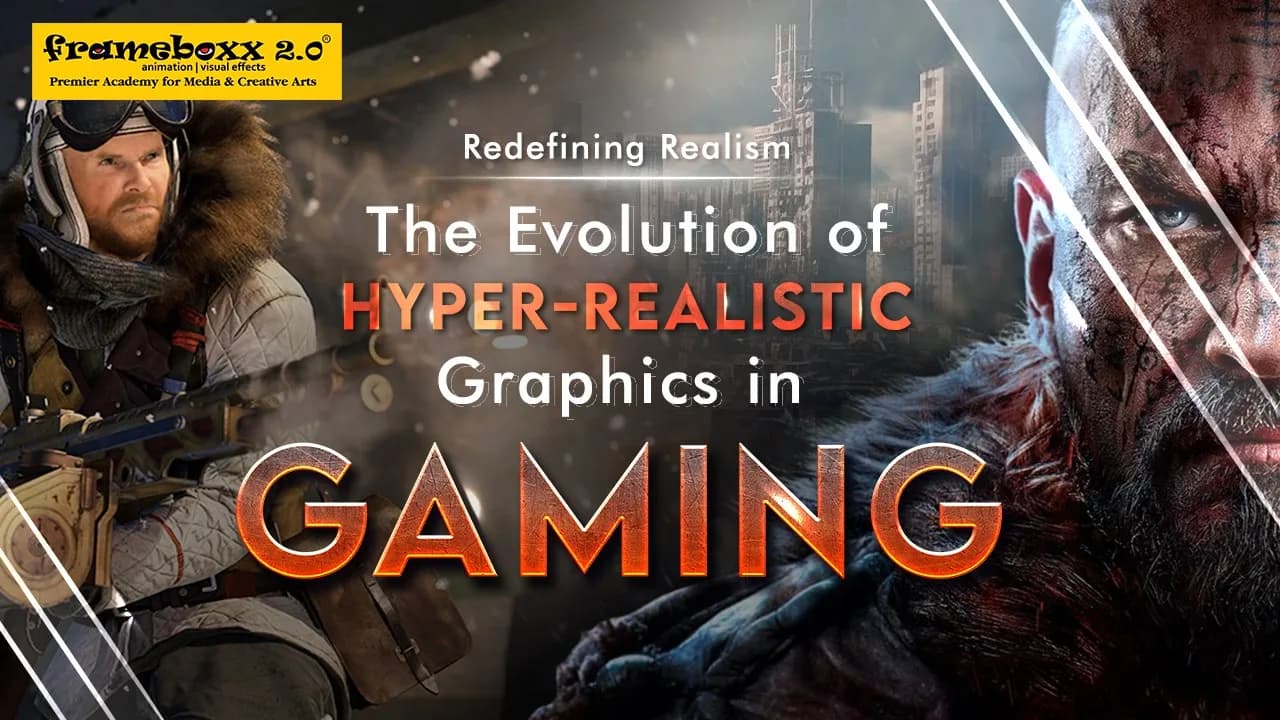
Many gamers argue that they prioritise gameplay over graphics. However, often, the game trailer seals the deal for the game designer, developer, and even the gamer. Find hyper-realistic graphics in gaming trailers to woo your expectations within seconds.
Such trailers showcase the gameplay to be realistic. You immediately want to install or download the game on your devices. That is why good graphics are always a notch higher in priority, in the long run, to visually appeal to the viewer and convert more.
Thus, if you're on a journey to become a graphic designer by enrolling in a specialised or master course from Frameboxx 2.0, this post is for you.
Read everything defining realism in gaming with its hyper-realistic graphics below before locking your first client/project.
Brief on Evolution of Hyper-realistic Graphics in Gaming
The world hyper-realism or hyperrealism came from an art dealer back in 1973. In the early 21st century, Denis Peterson, who is a renowned American painter, used hyperrealism in his paintings and shoots.
Whereas the early 1980s and 1990s were pivotal for the game development world. That happened starkly because of the emergence of 3D modelling. This was the era when the pixelated look and feel of a player took off.
Doom, Virtual Fighter, Runescape, and Wolfenstein 3D are some of the popular games of this era.
In 2000s, we saw the enhancements of game development and designing because of the advent usage of GPU technology and better rendering algoirthms.
Final Fantasy VII is one of the top games of that period with evolving 3D and lifelike graphics.
Then came the period of cel shading in the early and end of the 2000s. Because of this technique, 3D modelled graphics moved more extensively towards photorealism. The visuals were striking, appealing, more pronounced, and expressive because of cel shading.
From 2000s to 2010s we saw the age of realism coming alive. That happened with more advanced HD graphics, motion capture technology, and more complex shading methods.
It was the peak period for detail-oriented game designing and development. This technique helped game developers provide a whole new level of experience to the gamers.
They could start mimicking the real world better with stunning narratives and a wide spectrum of a player's emotional responses to scenes and episodes in a virtual game.
Currently, we are in the era of hyper-realistic graphics in gaming with the help of VR, AR, stylization, and more techniques.
Games like Red Dead Redemption 2, Astro Bot, and Cyberpunk 2077 are a few of the top ones in the list that fit the current era of hyperrealism in gaming.
Rendering Techniques for Accurate Interactions of Light Beams
Rendering helps graphic and game designers create virtual worlds by forming different images from a 3D world. Enable this by changing or modifying the behaviour and interaction of light with materials in the 3D world.
Following are the top rendering methods used in popular hyper-realistic games like Unrecorded or Subliminal.
Ray Tracing:
This technique replicates a chosen light beam extracted from a scene. Ray tracing has replaced rasterization in modern video games because it is more accurate in creating multiple simulations of light beams.
Game designers can get effects like refractions, reflections, and global illumination from ray tracing methods. Designers are able to trace each light's passage and introduce more accurate effects in the gameplay for a realistic feel and appeal.
Physically Based Rendering:
This method of rendering helps to duplicate or reproduce the real-life materials on the screen. It deals with the roughness, reflectivity, and subsurface scattering ratio of the scene.
It helps to recreate more realistic graphics on the screen by precisely calculating light beams. It maximises the usage of intricate materials of the shot, scene, or frame. It makes adding more intricacy in a game scene plausible with ease and precision.
Advanced Anti-Aliasing:
This method helps to reduce the jagged edges of the computer-generated/operated graphics/images. Other sub-categories of this method include:
• Multi-sample anti-aliasing (MSAA)
• Fast approximate anti-aliasing (FXAA)
• Temporal anti-aliasing (TAA)
TAA helps to remove temporal edges from the graphics to make those smoother and more appealing to viewers.
Advanced Texturing to Represent Real-World Materials Accurately
Advanced texturing helps bring more surface to the objects, elements, and characters in the game. This, in return, gives a more realistic feel and appeal to the user or player when playing the game.
Read 5 of its common techniques below:
Material scanning:
Graphic and game designers use this method to create high-fidelity images or textures. For this, they scan the real-life objects first using a machine similar to a 3D scanner. The digital recreation of the real-life objects from these scanner-like machines help to add more surface to colours, textures, and other elements to convert those into high-fidelity images.
Photogrammetry:
Under this technique, technicians photograph real-life elements, characters, or objects from different perspectives and angles. Then, highly 3D software analyses all these angles of the photographs to create a 3D model of a single image or object.
Surface maps:
Surface maps are used to add more realism to the given or chosen set of textures or images.
Texture painting:
For texture painting, game designers and developers use specialised tools and software. They then create bespoke textures using these tools. It is helpful to in creating a gameplay for sci-fi or fantasy games to add a out-of-the-world feel to real-life objects and creatures.
Texture streaming and compression:
Hi-fi images need to be compressed or reduced at times to fit the overall budgeted size of the gameplay sequence. Thus, with the compression technique, game designers shrink the file size without disrupting the quality.
Texture streamlining helps to load the images and sequences that have high priority to improve the current scene of the gameplay.
Advanced Animation for Lifelike Characters
Game designers use advanced animation techniques to introduce more lifelike characters into the game. Let's read about these techniques below:
Procedural animation:
Under this technique, game designers stimulate character's movement and behaviours by using algorithms. So, character's interaction with different object and elements in the game is fast and more intelligent.
Designers do not have to depend on the pre-set of the behaviours of the characters anymore. They can mould it as per the current storyboarding of the gameplay to redefine realism.
Facial animation:
Hyper-realistic graphics in gaming are even better with the effective emotions and expressions of a character. For that, hi-fi camera devices or facial tracking systems are helpful for game designers.
These tools track even the slightest and minuscule change in the character's face after every interaction in the game. It helps to make the projection of the character in the virtual space more realistic and lifelike.
Physics-based animation:
This procedure helps to animate the character based on the real-life physics theories and formula. This includes introducing concepts of gravity, motion, force, friction, mass, etc., into the gameplay.
These theories make your character's walk, jump, sprint, run, etc., more realistic while operating it.
Motion capture:
MoCap or Motion capture is a technique where real life actors perform some actions. These actions are then replicated in the virtual space or engine with the help of virtual or 3D characters.
The joints, movements, interactions, behaviours, etc., of these 3D characters, develop on the engine with the help of the markings by the hi-fi camera. This technique is basically helpful in refining the lifelike movements and expressions of the digital characters of the game.
We read about various stages of the evolution of hyper-realistic graphics in gaming in the post. Then we went beyond to educate you on topics in rendering, texturing, and advanced animation techniques. These bits and pieces of knowledge help you to get familiar with the world of hyper-realism in gaming.
Discover more from a course by Frameboxx 2.0 and be ready to design hyper-realistic graphics of your choice for the game you love.

Blog
Many gamers argue that they prioritise gameplay over graphics. However, often, the game trailer seals the deal for the game designer, developer, and even the gamer. Find hyper-realistic graphics in gaming trailers to woo your expectations within seconds.
Such trailers showcase the gameplay to be realistic. You immediately want to install or download the game on your devices. That is why good graphics are always a notch higher in priority, in the long run, to visually appeal to the viewer and convert more.
Thus, if you're on a journey to become a graphic designer by enrolling in a specialised or master course from Frameboxx 2.0, this post is for you.
Read everything defining realism in gaming with its hyper-realistic graphics below before locking your first client/project.
Brief on Evolution of Hyper-realistic Graphics in Gaming
The world hyper-realism or hyperrealism came from an art dealer back in 1973. In the early 21st century, Denis Peterson, who is a renowned American painter, used hyperrealism in his paintings and shoots.
Whereas the early 1980s and 1990s were pivotal for the game development world. That happened starkly because of the emergence of 3D modelling. This was the era when the pixelated look and feel of a player took off.
Doom, Virtual Fighter, Runescape, and Wolfenstein 3D are some of the popular games of this era.
In 2000s, we saw the enhancements of game development and designing because of the advent usage of GPU technology and better rendering algoirthms.
Final Fantasy VII is one of the top games of that period with evolving 3D and lifelike graphics.
Then came the period of cel shading in the early and end of the 2000s. Because of this technique, 3D modelled graphics moved more extensively towards photorealism. The visuals were striking, appealing, more pronounced, and expressive because of cel shading.
From 2000s to 2010s we saw the age of realism coming alive. That happened with more advanced HD graphics, motion capture technology, and more complex shading methods.
It was the peak period for detail-oriented game designing and development. This technique helped game developers provide a whole new level of experience to the gamers.
They could start mimicking the real world better with stunning narratives and a wide spectrum of a player's emotional responses to scenes and episodes in a virtual game.
Currently, we are in the era of hyper-realistic graphics in gaming with the help of VR, AR, stylization, and more techniques.
Games like Red Dead Redemption 2, Astro Bot, and Cyberpunk 2077 are a few of the top ones in the list that fit the current era of hyperrealism in gaming.
Rendering Techniques for Accurate Interactions of Light Beams
Rendering helps graphic and game designers create virtual worlds by forming different images from a 3D world. Enable this by changing or modifying the behaviour and interaction of light with materials in the 3D world.
Following are the top rendering methods used in popular hyper-realistic games like Unrecorded or Subliminal.
Ray Tracing:
This technique replicates a chosen light beam extracted from a scene. Ray tracing has replaced rasterization in modern video games because it is more accurate in creating multiple simulations of light beams.
Game designers can get effects like refractions, reflections, and global illumination from ray tracing methods. Designers are able to trace each light's passage and introduce more accurate effects in the gameplay for a realistic feel and appeal.
Physically Based Rendering:
This method of rendering helps to duplicate or reproduce the real-life materials on the screen. It deals with the roughness, reflectivity, and subsurface scattering ratio of the scene.
It helps to recreate more realistic graphics on the screen by precisely calculating light beams. It maximises the usage of intricate materials of the shot, scene, or frame. It makes adding more intricacy in a game scene plausible with ease and precision.
Advanced Anti-Aliasing:
This method helps to reduce the jagged edges of the computer-generated/operated graphics/images. Other sub-categories of this method include:
• Multi-sample anti-aliasing (MSAA)
• Fast approximate anti-aliasing (FXAA)
• Temporal anti-aliasing (TAA)
TAA helps to remove temporal edges from the graphics to make those smoother and more appealing to viewers.
Advanced Texturing to Represent Real-World Materials Accurately
Advanced texturing helps bring more surface to the objects, elements, and characters in the game. This, in return, gives a more realistic feel and appeal to the user or player when playing the game.
Read 5 of its common techniques below:
Material scanning:
Graphic and game designers use this method to create high-fidelity images or textures. For this, they scan the real-life objects first using a machine similar to a 3D scanner. The digital recreation of the real-life objects from these scanner-like machines help to add more surface to colours, textures, and other elements to convert those into high-fidelity images.
Photogrammetry:
Under this technique, technicians photograph real-life elements, characters, or objects from different perspectives and angles. Then, highly 3D software analyses all these angles of the photographs to create a 3D model of a single image or object.
Surface maps:
Surface maps are used to add more realism to the given or chosen set of textures or images.
Texture painting:
For texture painting, game designers and developers use specialised tools and software. They then create bespoke textures using these tools. It is helpful to in creating a gameplay for sci-fi or fantasy games to add a out-of-the-world feel to real-life objects and creatures.
Texture streaming and compression:
Hi-fi images need to be compressed or reduced at times to fit the overall budgeted size of the gameplay sequence. Thus, with the compression technique, game designers shrink the file size without disrupting the quality.
Texture streamlining helps to load the images and sequences that have high priority to improve the current scene of the gameplay.
Advanced Animation for Lifelike Characters
Game designers use advanced animation techniques to introduce more lifelike characters into the game. Let's read about these techniques below:
Procedural animation:
Under this technique, game designers stimulate character's movement and behaviours by using algorithms. So, character's interaction with different object and elements in the game is fast and more intelligent.
Designers do not have to depend on the pre-set of the behaviours of the characters anymore. They can mould it as per the current storyboarding of the gameplay to redefine realism.
Facial animation:
Hyper-realistic graphics in gaming are even better with the effective emotions and expressions of a character. For that, hi-fi camera devices or facial tracking systems are helpful for game designers.
These tools track even the slightest and minuscule change in the character's face after every interaction in the game. It helps to make the projection of the character in the virtual space more realistic and lifelike.
Physics-based animation:
This procedure helps to animate the character based on the real-life physics theories and formula. This includes introducing concepts of gravity, motion, force, friction, mass, etc., into the gameplay.
These theories make your character's walk, jump, sprint, run, etc., more realistic while operating it.
Motion capture:
MoCap or Motion capture is a technique where real life actors perform some actions. These actions are then replicated in the virtual space or engine with the help of virtual or 3D characters.
The joints, movements, interactions, behaviours, etc., of these 3D characters, develop on the engine with the help of the markings by the hi-fi camera. This technique is basically helpful in refining the lifelike movements and expressions of the digital characters of the game.
We read about various stages of the evolution of hyper-realistic graphics in gaming in the post. Then we went beyond to educate you on topics in rendering, texturing, and advanced animation techniques. These bits and pieces of knowledge help you to get familiar with the world of hyper-realism in gaming.
Discover more from a course by Frameboxx 2.0 and be ready to design hyper-realistic graphics of your choice for the game you love.